
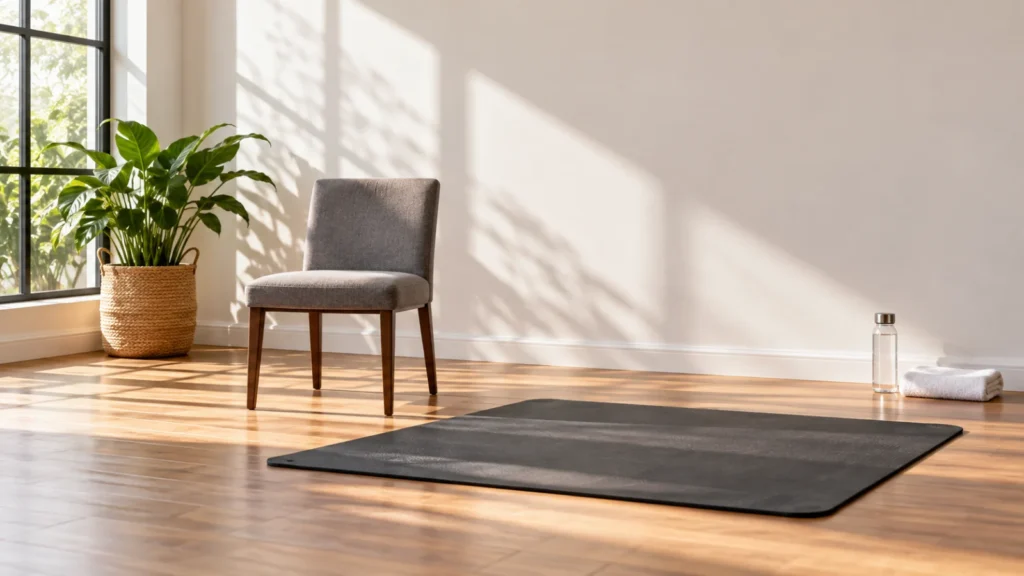
Understand a movement before adding more.
These concise references complement the full session guides. They are not individualized exercise prescriptions, rehabilitation plans or validated video demonstrations. Begin only with suitable movements, use a stable setup and seek qualified instruction when needed. Try a small comfortable practice rather than treating a repetition count as mandatory.
Sit-to-stand
Equipment: Stable armless chair on a nonslip surface
Practice controlled rising and sitting.
Movement guidance
- Sit near the front, feet comfortably apart and flat.
- Lean slightly forward and rise slowly, looking ahead.
- Return to sitting with control; use appropriate hand support if needed.
Modification: Use a smaller practice or seek help with chair height and assistance.
Safety: Use a stable setup and comfortable range. Stop for pain, dizziness or concerning symptoms; seek appropriate advice if suitability is uncertain. These descriptions are educational, not rehabilitation prescriptions.
Supported heel raise
Equipment: Stable chair for hand support
Practice a controlled heel lift.
Movement guidance
- Stand behind the chair with hands supported.
- Raise both heels only within a comfortable range.
- Lower slowly; keep support throughout.
Modification: Use fewer repetitions and a smaller lift; do not remove support to make it harder.
Safety: Use a stable setup and comfortable range. Stop for pain, dizziness or concerning symptoms; seek appropriate advice if suitability is uncertain. These descriptions are educational, not rehabilitation prescriptions.
Wall press-up
Equipment: Solid wall and nonslip floor
Practice a gentle upper-body pushing movement.
Movement guidance
- Face a solid wall about arm’s length away; hands at chest height.
- Keep the body aligned and bend the elbows slowly toward the wall.
- Press back smoothly without bouncing or holding the breath.
Modification: Use a smaller comfortable range and obtain instruction about distance and alignment.
Safety: Use a stable setup and comfortable range. Stop for pain, dizziness or concerning symptoms; seek appropriate advice if suitability is uncertain. These descriptions are educational, not rehabilitation prescriptions.
Seated march
Equipment: Stable armless chair, feet initially flat
Practice controlled alternating leg movement.
Movement guidance
- Sit upright and hold the chair sides as needed.
- Lift one bent knee a comfortable small distance.
- Set the foot down gently, then alternate.
Modification: Reduce lift height or pause; choose another suitable movement if uncomfortable.
Safety: Use a stable setup and comfortable range. Stop for pain, dizziness or concerning symptoms; seek appropriate advice if suitability is uncertain. These descriptions are educational, not rehabilitation prescriptions.
Seated ankle motion
Equipment: Stable chair
Explore gentle ankle movement.
Movement guidance
- Sit upright, supported as needed.
- Gently straighten one leg sufficiently to move the ankle comfortably.
- Point and draw back the toes without forcing, then change sides.
Modification: Use a smaller range or seek guidance if holding the leg is difficult.
Safety: Use a stable setup and comfortable range. Stop for pain, dizziness or concerning symptoms; seek appropriate advice if suitability is uncertain. These descriptions are educational, not rehabilitation prescriptions.
Comfortable seated neck turn
Equipment: Stable chair
Explore a small comfortable neck rotation.
Movement guidance
- Sit upright with shoulders relaxed and look forward.
- Turn the head slowly toward one side within comfort.
- Return to center; repeat gently on the other side.
Modification: Use a smaller turn; never use a hand to force the head farther.
Safety: Use a stable setup and comfortable range. Stop for pain, dizziness or concerning symptoms; seek appropriate advice if suitability is uncertain. These descriptions are educational, not rehabilitation prescriptions.
Supported calf stretch
Equipment: Solid wall, level nonslip floor
Explore a gentle calf stretch.
Movement guidance
- Place hands on the wall for support.
- Step one foot back with heel down, front knee comfortably bent.
- Keep the rear leg comfortably straight; change sides without bouncing.
Modification: Use a shorter stance and smaller stretch; avoid any painful position.
Safety: Use a stable setup and comfortable range. Stop for pain, dizziness or concerning symptoms; seek appropriate advice if suitability is uncertain. These descriptions are educational, not rehabilitation prescriptions.
Small standing side bend
Equipment: Clear level floor
Explore comfortable side movement.
Movement guidance
- Stand upright with feet comfortably apart.
- Slide one hand a small distance down the same side.
- Return smoothly and repeat on the other side without twisting.
Modification: Use a very small range or seek a suitable supported alternative if balance is uncertain.
Safety: Use a stable setup and comfortable range. Stop for pain, dizziness or concerning symptoms; seek appropriate advice if suitability is uncertain. These descriptions are educational, not rehabilitation prescriptions.
Keep the context
Source review: October 29, 2026. Read the linked primary references and follow individual advice. Stop for concerning symptoms. Visit the Workout Finder to read complete activity guides.